Guido del Duca
Guido del Duca is a penitent soul encountered by Dante Alighieri and Virgil on the Second Terrace of Mount Purgatory, where the sin of envy is cleansed. A nobleman from the Romagna region of thirteenth-century Italy, he embodies the self-consuming nature of envy and serves as one of the poem's most passionate moral commentators. His extended discourse with Dante offers a sustained, bitter indictment of the moral decay he sees in the cities of the Arno Valley and in his native Romagna, framed by his own painful purgation and a deep, elegiac longing for a lost world of courtesy, honor, and virtue.
Identity and Background
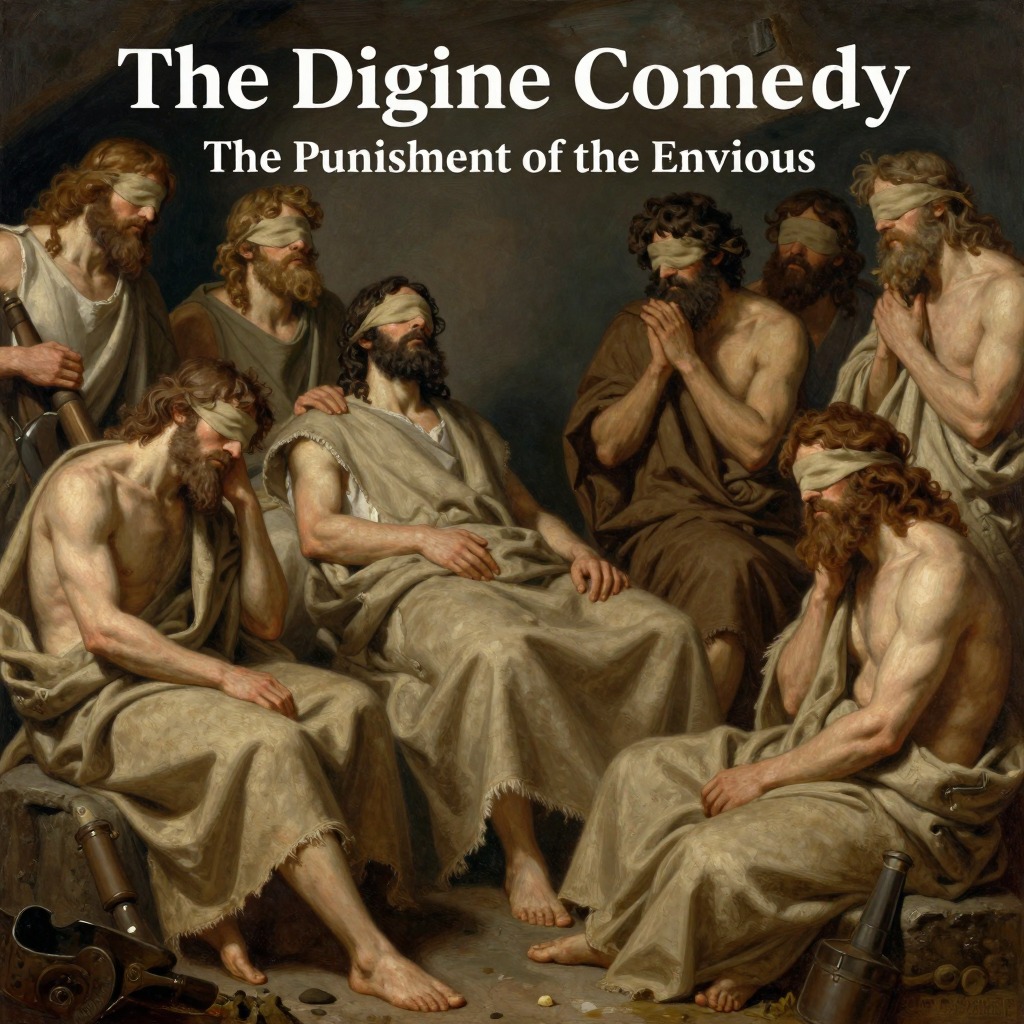
Guido del Duca identifies himself to Dante by name, declaring, "Know, then, that I Guido del Duca am." He is a nobleman from the Romagna region, a territory in northern Italy that he describes with intimate knowledge of its families and cities. His confession reveals the central sin that defines his earthly life and his present suffering: envy. He states, "My blood was so with envy set on fire, / That if I had beheld a man make merry, / Thou wouldst have seen me sprinkled o'er with pallor." This visceral reaction—a physical pallor at the sight of another's joy—captures the essence of his sin. He acknowledges the justice of his punishment with a grim, proverbial resignation: "From my own sowing such the straw I reap!" His presence on the Second Terrace, where the envious have their eyes sewn shut with iron wire and wear coarse mantles the color of the stone, is a direct consequence of this lifelong disposition.
Life and Plot Trajectory
Guido del Duca appears in Canto XIV of the Purgatorio, as Dante and Virgil ascend the mountain. He is first heard in conversation with another penitent, Renier da Calboli, as they speculate about the living man who walks among them. Guido is the one who directly addresses Dante, asking him to declare his origin. When Dante obliquely refers to the Arno River, Guido immediately understands and launches into a scathing allegorical denunciation of the river's valley and its inhabitants. He describes the Arno's course from its source in the Apennines to the sea, characterizing the people of each region through a descending bestiary: swine in the Casentino, curs in Arezzo, wolves in Florence, and foxes in Pisa. This prophecy of moral degradation is directed at the corruption of his own time. Later, after identifying himself, he turns his lament to Romagna, reciting a litany of noble families—the Traversara, the Anastagi, the house of Calboli—that have died out or degenerated, and he weeps openly at the memory of a lost age of "dames and cavaliers, the toils and ease / That filled our souls with love and courtesy."
Key Actions and Objectives
Guido del Duca's primary action in the poem is his speech. He is a prophet of doom and a mourner for a vanished world. His objective is not to seek prayers for himself—he does not ask Dante to intercede for his own soul—but to bear witness to the truth as he sees it. He delivers a comprehensive moral geography of the Arno Valley, transforming a simple river into a symbol of progressive corruption. He then extends his critique to Romagna, naming specific families and individuals who have failed to live up to their ancestors. His lament is a form of purgation, a verbal expression of the sorrow that his envy caused him to suppress in life. He tells Dante, "it now delights me / To weep far better than it does to speak, / So much has our discourse my mind distressed." The act of weeping, of giving voice to his grief, is itself part of his penitential work.
Relationships and Conflict
Guido del Duca's primary relationship in the text is with his fellow penitent, Renier da Calboli, whom he introduces to Dante as "the boast and honour / Of the house of Calboli, where no one since / Has made himself the heir of his desert." This introduction is tinged with both praise and lament, as Renier represents the last flicker of a dying flame. Guido's conflict is not with other characters but with the moral state of his world. He is in a state of profound opposition to the avarice, envy, and pride that he sees everywhere around him. His speech is filled with a righteous anger that is itself a form of suffering, as he recalls the virtues that have been extinguished. His conflict is internal as well: he must purge the envy that made him resent the happiness of others, and his weeping is the outward sign of this inner struggle.
Change and Ending
Guido del Duca undergoes no dramatic transformation within the brief span of his encounter with Dante. His change is the slow, ongoing process of purgation itself. He is already in a state of grace, working through his sin by experiencing the opposite of envy: he now weeps at the good fortune of others (the memory of past virtue) and laments the evil he sees, rather than resenting it. His ending in the poem is a withdrawal into his own sorrow. After his long discourse, he tells Dante to go, saying, "it now delights me / To weep far better than it does to speak." He turns away from the conversation and back to his own penitential grief, leaving Dante and Virgil to continue their ascent. His final state is one of active, sorrowful contemplation, the necessary prelude to the joy that awaits him at the summit of the mountain.
Narrative Role and Evaluation
Guido del Duca functions as a powerful moral chorus within the Purgatorio. His voice is one of the most sustained and bitter critiques of contemporary society in the entire poem. He is a round character in E. M. Forster's sense: he is capable of surprising the reader with the depth of his grief and the scope of his vision. He is not merely a flat emblem of envy but a complex figure who combines a confession of personal sin with a sweeping social and political prophecy. His speech is a key moment in Dante's education, providing the pilgrim with a detailed, allegorical understanding of the corruption that plagues Italy. Guido del Duca's lament for the lost world of courtesy and chivalry gives voice to a central theme of the Commedia: the moral decay of the present age and the yearning for a restoration of virtue and order.